


Everyone loves a good berry!
They bring color and sweetness into your kitchen, indicating the coming of summertime. Modern growing practices however enable growing these delicious fruit out of season. This is how supermarkets can offer the popular fruit all year round. Large distance transport of berries from areas with warmer climates (such as California) has become a popular practice. Research however shows that a strawberry grown on the US west coast and shipped to the east coast uses 15 times the energy it contains.
In addition to energy, it is well known that growing berries uses up large volumes of water and demands annual fumigation for pest control. Proper plant management is also important so that ripe fruit is not lost, and weeding is yet another challenge. All this translates to cost for growers. One solution for growing berries off season is tunnel growing. This article will review challenges, best practices and products that help in this endeavor in both high and low tunnels.
Many growers in the US are adopting tunnel growing methods for their berry crops. The benefits of protected culture growth methods are obvious: growers control the plant environment for enhanced weed and pest control, regulated water use, as well as controlled temperature, light and humidity. The result – more yields, higher fruit quality, for extended growing periods. The bottom line, ROI – more revenue generated with a controlled budget.
Tunnels increase plant survival, offering protection from harsh climates and enabling growth in both warmer and colder regions. Tunnel films also help protect crops from extreme weather (e.g. hail or wind) and prevent fruit being damaged by dear and insects. Varied research has shown that tunnels facilitate better growing results – tasty berries, fewer culls – and are acting as a valuable risk management tool to protect farmers against heavy loss.
Tunnels can also create challenges. Ventilation is a time consuming operation that calls for automation solutions but is necessary to achieve pest, climate and environmental control in the growing area. Temperature control is a challenge, but the predictable environment can be used to better manage labor. As harvesting and weeding are often still conducted by hand, labor in lower tunnels is especially challenging as plants may be hard to reach. High tunnels bring with them various construction and labor challenges, as they must be, stable without being too heavy, and easy to build. They also must withstand extreme weather.
Mechanization and automation inside tunnels is complex and scaling for wholesale is therefore not easy. The cost of the tunnel needs to be balanced against the length of the harvest season and the size of the growing area for it to pay off. There is clearly a learning curve.
Ginegar offers a variety of tunnel films and mulch films to help growers achieve the perfect environment for their crops. Mulch films keep the soil warm and the weeds away; this is especially good for growing strawberries. Mulch films also allow for crop induction and facilitate water conservation, resulting in earlier harvest with operating efficiencies. There are mulch films that also allow for light reflection, keeping insects at bay and providing enhanced illumination in addition to warm soil for boosting plant growth. This is especially effective in colder climate areas.
Our tunnel films are in high demand. Ginegar’s multi-layer tunnel film is extra strong, enabling the use of thinner and lighter film to construct high tunnels that are durable. Furthermore we offer diffusion, IR and anti-dust functionalities. Our Open UV Nectarin covers allow for light regulation to enable intensified fruit color – it especially improves the red color of the strawberries and raspberries. In addition, it increases the sugar accumulation, raises the brix, and improves precocity. Our shading nets complete the picture, facilitating an effective, environmentally controlled berry-growing area.
Growing berries can enhance farm revenue and profitability if done right. The popular fruits are best sellers. In the US alone, strawberries and raspberries are in high demand with a combined production value of B$3.8 in 2017. The season extension is creating new marketing opportunities for growers, allowing them to diversify and grow berries for local markets, sell directly to customers, gain entry to wholesale markets and sell produce to the preserves market.
By making use of tunnel growing methods, with innovative recyclable materials, farmers have increased the yield of marketable berries. By using tunnel films, mulch films and open UV covers growers are overcoming berry growing challenges and are achieving excellent yields and high berry quality for longer periods, while maintaining their budgets and increasing profitability.
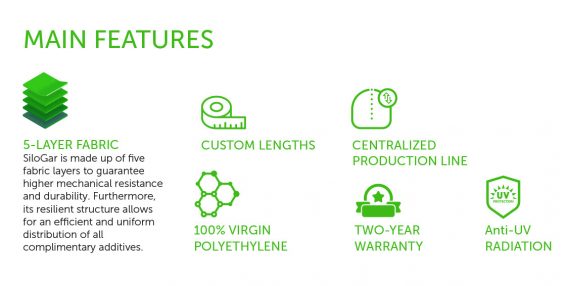

ADVANTAGES
Excellent alternative to traditional storage methods
Lower costs per each grain-storage sack
Easy method to expand storage capacity
Lower shipping costs
Investements adjusted to production rates
Separate storage of diffetent grains inside one silobag
The products stored in SiloGar can be easily identified through conventional means, plus…
It preserves the quality and original color of grains,
Minimizes the heavy cost of leaving combines inactive for some time,
Can be quickly used for large harvests, and Is adaptable to extreme climates, whether hot or cold
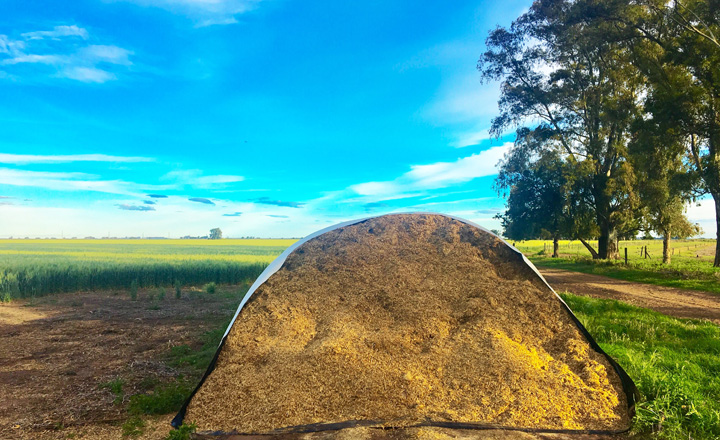
The ultimate way to store
Grains
Silages
Forragens
For more info ,please contact us: export@ginegar.co.il
becoming ever more intensive. Those who participate in it, strive to yield more, of better quality from smaller growing units. In this Ginegar has unique abilities, knowledge and products to contribute” Ginegar is proudly counting 45 years of experience in the field yet it still is young and vibrant. Its products are sold to and used in more than 60 countries. “We have wide geographical deployment and dominant presence in many important markets. Ginegar corporate’s base is in Kibbutz Ginegar, in the north of Israel. It possesses 3 manufacturing sites in Israel (Kibbutz Ginegar for Films, Kibbutz Nir Yitzhak- for knitted products, Kibbutz Neot Mordehai – for woven products). It also has production site in Brazil (SP) for knitted and woven products. “As part of Ginegar’s quest to remain world leader not only in product quality but also in service quality, we founded 3 subsidiaries (in USA, Brazil and India) enabling us to get closer to our customers, understanding better the global trends and local needs and build commensurate availability of products and services.
“We think that service and reliability are no less important component of the quality in the eyes of the customer, than the product itself. We are constantly striving accordingly. “We stay in constant contact with greenhouses constructors, who by being in constant, direct contact with the users of our products, are among the first to identify needs to replace worn-out products (after 3-4 years of use), as well as changes in market trends or needs. Moshe continues and talk about Ginegar’s spirit of innovation. “We were the first in the world to introduce 3 layers’ films and pioneered the development and application of the 5 layers’ technology in agriculture films. The multilayers technology enables optimization of the distribution and allocation of raw-material, achieving improved mechanical and photo-selective products’ characteristics for the users’ benefit. About four year ago, Ginegar acquired the agriculture activity of Polysack of Nir Itzhak, which developed and manufactured nets for the agriculture. “To our understanding” affirms Moshe “the Agri-Nets is a complementary product perfectly suiting our idea of Covering the World with Care”