


Thermal Shading Nets Protect Banana Crops from Frostbite
Every farmer will tell you it’s not called frost “bite” for nothing. When there is a frost and the temperature drops, reality bites! Banana crops are especially sensitive to frost damages, as the plant is tropical and it grows by nature in moderate climates.
In agriculture, frost is defined as a climatic occurrence, in which the temperature of the plant tissue is under water freezing point. Frostbite causes severe damages to the banana crop, leading to loss of fruit and income. The fruit shortage has a significant impact on the banana market. As prices rise, pressure increases on producers due to import threats and the ever growing insurance costs. In fact insurance premium for banana crops in Israel has almost doubled in the last four years, following consecutive occurrences of frost.
Records in Israel in the last 54 years show that on average, every 3rd year is a frost year. But the last four years demonstrated a negative sequence record of frost, assumed to be caused by global temperature changes. Global weather is becoming more extreme, with winters becoming colder and drier as the amount of clouds decreases. Clouds have a moderating effect on radiative frost, their loss is therefore a double blow to banana growers.
Past attempts to protect banana orchards included diverse means, among which were sprinkles, wind turbines, burning fuel bricks and even helicopters. The helicopters were in fact proven to be the most efficient but were regrettably also unaffordable. Recent research results have proven that once again the solution to a complex problem is rather simple. As it turns out, banana orchids can be protected by thermal shading nets.
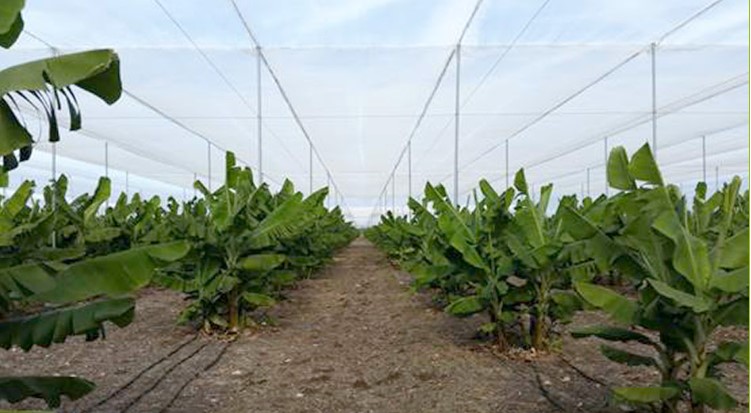
Dr. Navot Galpaz et al*, began an observatory comparison in the winter of 2015 to test the effectiveness of Aluminet® shading nets – polyethylene nets coated with aluminum. The results of the research demonstrate that the thermal shading nets prove very effective in protecting banana crops from frostbite.
The thermal effect
The aluminum coating prevents the exit of infra-red radiation, which radiates from hot objects such as water, plants and earth. This infra-red conservation allows for an increase of temperature in the structure. During radiative frost, this extra heat, becomes important. The heat and humidity of the plants and the ground inside the greenhouse structure is preserved relative to outside temperature, thus preventing damage from frost.
The shading gradient
Dr. Galpaz’s research shows that the level of shading is crucial to effective frostbite protection of crops. The more shading, the better the protection. The threshold was at 50%. Aluminet 50% shading provided sufficient protection from frostbite damages. However, under Aluminet 30%, 40% and Crystal 12% significant frost damage was observed as plant leaves dried and turned brown.
At Ginegar plastics, we offer varied solutions that make the most of the thermal effect, the shading gradient or both.
Aluminet accumulates the benefits of climate control and light diffusion to create a micro environment in the greenhouses and nurseries, protecting plants from cold, pests, UV, over-heating and direct sunlight. Moreover, the nets are lightweight, flexible, easily installed and provide shading control. Yields are improved with 25%-40% saving of irrigation costs.
The Sun Saver thermal film product line has been designed with the thermal effect in mind. The infra-red additive added to the films preserves the long infra-red radiation within the greenhouse, conserving heat and humidity and creating a moderate a stable environment for the crops inside. Cooling of foliage is thus prevented, the very definition of frostbite never materializes and the crops remain healthy. Thermal cover films have proven to increase crop yields while contributing to heat cost savings.
Bananas like it hot! With Ginegar smart cover solutions, they get just that!
* Dr. Galpaz N. and OR G. in collaboration with R&D North Dept. of the Israeli Ministry of Agriculture and Ashgach Banana Growers, West Galilee

“Our R&D in conjunction with the academy, direct much of its efforts and resources to ever improve Ginegar’s products traits as well as to constantly increase the array of available solution for application and needs, helping generate bigger and growing benefits to the growers. “We are constantly investing in finding ways to tailoring products to needs, for which – I am proud to say – Giengar’s team includes professional agronomists who stay in close, professional contact with growers to bring understanding from the field and to deliver professional solutions back to the growers.
“We, at Ginegar, strongly believe that the business we are in, is in constant growing and is bound to continue so in the foreseeable future. “The growing world population, the increasing scarcity of available water and farm land, together with the ever- increasing demand for affordable food, are expected to continue driving the need for our products. These assumptions are the main drivers of our investment in R&D, machinery and products-range. “Agriculture these days” explains Moshe, “is bound to

becoming ever more intensive. Those who participate in it, strive to yield more, of better quality from smaller growing units. In this Ginegar has unique abilities, knowledge and products to contribute” Ginegar is proudly counting 45 years of experience in the field yet it still is young and vibrant. Its products are sold to and used in more than 60 countries. “We have wide geographical deployment and dominant presence in many important markets. Ginegar corporate’s base is in Kibbutz Ginegar, in the north of Israel. It possesses 3 manufacturing sites in Israel (Kibbutz Ginegar for Films, Kibbutz Nir Yitzhak- for knitted products, Kibbutz Neot Mordehai – for woven products). It also has production site in Brazil (SP) for knitted and woven products. “As part of Ginegar’s quest to remain world leader not only in product quality but also in service quality, we founded 3 subsidiaries (in USA, Brazil and India) enabling us to get closer to our customers, understanding better the global trends and local needs and build commensurate availability of products and services.
“We think that service and reliability are no less important component of the quality in the eyes of the customer, than the product itself. We are constantly striving accordingly. “We stay in constant contact with greenhouses constructors, who by being in constant, direct contact with the users of our products, are among the first to identify needs to replace worn-out products (after 3-4 years of use), as well as changes in market trends or needs. Moshe continues and talk about Ginegar’s spirit of innovation. “We were the first in the world to introduce 3 layers’ films and pioneered the development and application of the 5 layers’ technology in agriculture films. The multilayers technology enables optimization of the distribution and allocation of raw-material, achieving improved mechanical and photo-selective products’ characteristics for the users’ benefit. About four year ago, Ginegar acquired the agriculture activity of Polysack of Nir Itzhak, which developed and manufactured nets for the agriculture. “To our understanding” affirms Moshe “the Agri-Nets is a complementary product perfectly suiting our idea of Covering the World with Care”